
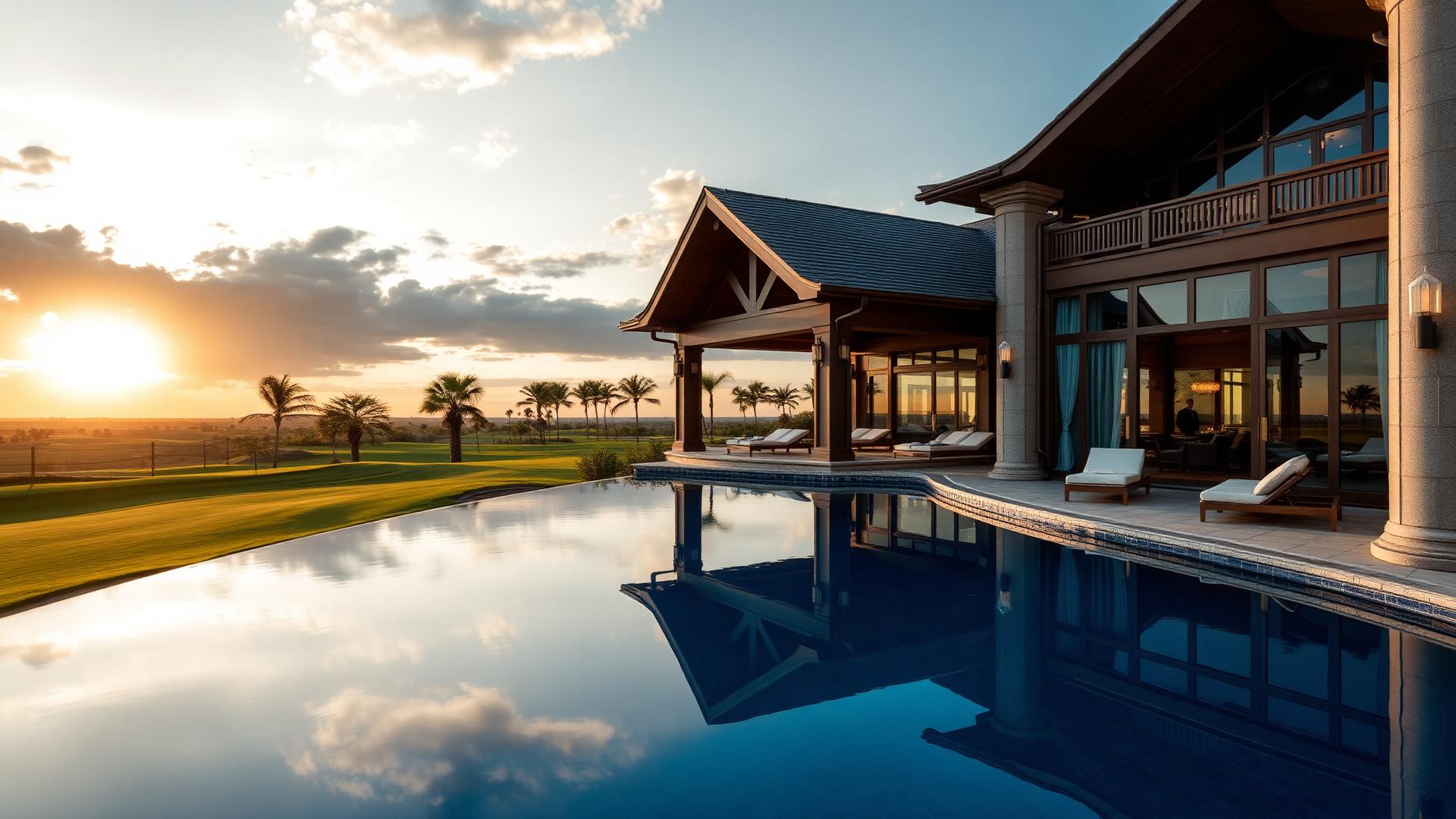
Luxury Golf
Member-only sanctuaries, private club access, and the resorts that define hospitality in the game.
- Clubs Profiled
- 60+
- Resorts Reviewed
- 35
- Countries Covered
- 14
- Editor Visits / Yr
- 120+
Luxury golf is less a price point than a posture: it is the way a club greets a guest at the gate, the cadence of a caddie's pre-shot information, and the quiet that a 6:14 a.m. tee time on a Tuesday in October buys you. ResortGolfer's luxury coverage focuses on what that posture actually feels like, where it is durable, and where it has slipped — from Augusta and Cypress Point to Morfontaine, Hirono, and Royal Melbourne.
Our editors have walked the property at every club referenced in this hub, either as members, member guests, or invited press under our standing disclosure policy. We accept no payment from clubs, resorts, or hospitality groups, and we do not negotiate access in exchange for coverage. When we recommend a destination — Pebble Beach, The Greenbrier, Sea Island, Hirono, or a private members-only sanctuary — the recommendation reflects what we believe the experience justifies relative to its cost, not what the property paid us to say.
The luxury market spans three distinct categories: ultra-private member clubs (Augusta National, Cypress Point, Seminole, Pine Valley) where access is governed by membership or a member's personal invitation; high-end public-access resorts (Pebble Beach, Bandon Dunes, Pinehurst, Streamsong) where premium pricing buys a curated stay-and-play experience; and international members' clubs (Morfontaine in France, Hirono in Japan, Royal Melbourne in Australia) where reciprocal access through home-club affiliations is the most reliable path through the door. Each demands a different planning posture; we cover the practical mechanics of all three.
What separates a great luxury golf experience from a merely expensive one is consistency of standard across every touchpoint: bag drop, locker assignment, caddie pairing, halfway-house provisioning, post-round food and beverage, and the texture of the conversation in the men's or mixed grill. ResortGolfer's reviews score these touchpoints explicitly on a normalized framework so a reader can compare The Lodge at Pebble Beach against The Greenbrier or Sea Island's Cloister without translating between marketing decks. We publish the framework openly on our review methodology page.
“The defining luxury of a great private club is not the food, the locker, or the practice facility — it is the absence of friction at every step from valet to first tee.”
Inside the luxury market
Editorial entry points into the clubs, resorts, and logistics of high-end golf travel.
Private Club Profiles
Augusta, Cypress, Seminole, Pine Valley — how access actually works.
Luxury Resorts
Pebble Beach, The Greenbrier, Sea Island, Streamsong, Pinehurst.
International Members' Clubs
Morfontaine, Royal Melbourne, Hirono, Naruo, Sunningdale.
Reciprocal Access
Using your home-club membership to play overseas.
Private Aviation & Golf
Logistics of the long weekend — jets, jet cards, and timing.
Concierge Tee Times
How third-party concierge services actually book Pebble or Augusta-week stays.
Caddie Programs
Where caddies are exceptional, mandatory, optional, or absent — and why it matters.
Heritage Brands
The clubmakers, apparel houses, and bag makers behind the experience.
About Luxury Golf
- How do you actually get on Augusta National, Cypress Point, or Pine Valley?
- Each of the three works differently. Augusta National hosts the Masters and a small number of member-guest rounds outside tournament season; outside guest play is essentially impossible without a member host. Cypress Point operates the same way — strictly as a member's guest. Pine Valley is similar but has historically been slightly more accessible to invited media and reciprocal members from peer top-tier clubs. The practical path for all three is the same: cultivate a relationship with a member over time, never ask directly, and accept that an invitation is a gift the member chooses to extend. There is no booking, lottery, or paid-access route.
- What's the difference between a luxury resort and a private members' club?
- A luxury resort (Pebble Beach, The Greenbrier, Sea Island, Streamsong, Pinehurst, Kiawah, Bandon Dunes) sells access — you can book a stay, pay a premium green fee, and play. A private members' club (Augusta, Cypress, Seminole, Pine Valley, Morfontaine, Hirono) does not — access is governed by membership and member invitation. The two categories often share architects, conditioning standards, and hospitality norms, but the access mechanics are fundamentally different. ResortGolfer covers both, with separate reviewing standards for each.
- What does a luxury golf trip realistically cost in 2026?
- For a 3-night, 3-round stay at Pebble Beach Resorts in shoulder season, expect roughly $4,500–$6,500 per person including room, green fees, caddie, and gratuity — not including travel or food and beverage. The Greenbrier and Sea Island typically run $2,800–$4,500 for the same pattern. Bandon Dunes is the most surprising on price-to-quality, often $2,200–$3,200. International destinations vary wildly — Hirono or Morfontaine through reciprocal access can be modest in green fee but expensive in travel; Cabo and St Andrews fall between. Our destination guides publish current pricing windows.
- Is a caddie worth it at a luxury course?
- Almost always yes, and at certain courses (Pebble Beach, Bandon Dunes, Pinehurst No. 2, Augusta during a member-guest round) it is either mandatory or so strongly recommended that declining marks you immediately as a first-timer. A good caddie at a course you have never played is worth two or three strokes through green reading and club selection alone, and often more through course-management instinct that no yardage book captures. Budget $100–$200 per bag plus a tip of 50–100 percent of the fee.
- How does ResortGolfer rate luxury properties without taking comped stays?
- Our editors pay for their own travel, lodging, and green fees on every property we review, with rare exceptions for invited-press events that we disclose in the review's transparency footer. We rate properties on a normalized 0–10 framework that weights course quality, conditioning, hospitality consistency, food and beverage, practice facilities, and value-for-cost relative to the property's stated price tier. The full methodology is published on our review methodology page.
- What is reciprocal access and how do I use it?
- Reciprocal access is a standing arrangement between private clubs where a member in good standing of Club A can request play at Club B, typically through their home-club secretary or a written letter of introduction. The classic use case is an American member of a top-50 US private club requesting access to Sunningdale, Royal St George's, or Morfontaine on a UK or European trip. Practical rules: write the request three to four months ahead through your secretary, accept the dress code, walk if walking is the norm, hire a caddie if caddies are available, and write a handwritten thank-you note afterward. Reciprocal access is a privilege the receiving club extends voluntarily; abuse damages access for every future member.
- Which international members' clubs are easiest to access as a visiting golfer?
- Easiest tier (often available with a letter of introduction or modest member sponsorship): Sunningdale Old, Walton Heath, Wentworth, and many top European clubs outside major championships. Mid tier (require established reciprocal or a real member relationship): Morfontaine, Royal St George's, Royal Melbourne, Hirono, Kingston Heath. Hardest tier (member host essentially required): Muirfield outside the limited weekday visitor window, Augusta National, Cypress Point, Pine Valley, Seminole, and most ultra-private US clubs. Our country-by-country guides under Golf Travel cover the current state of access for each region.