
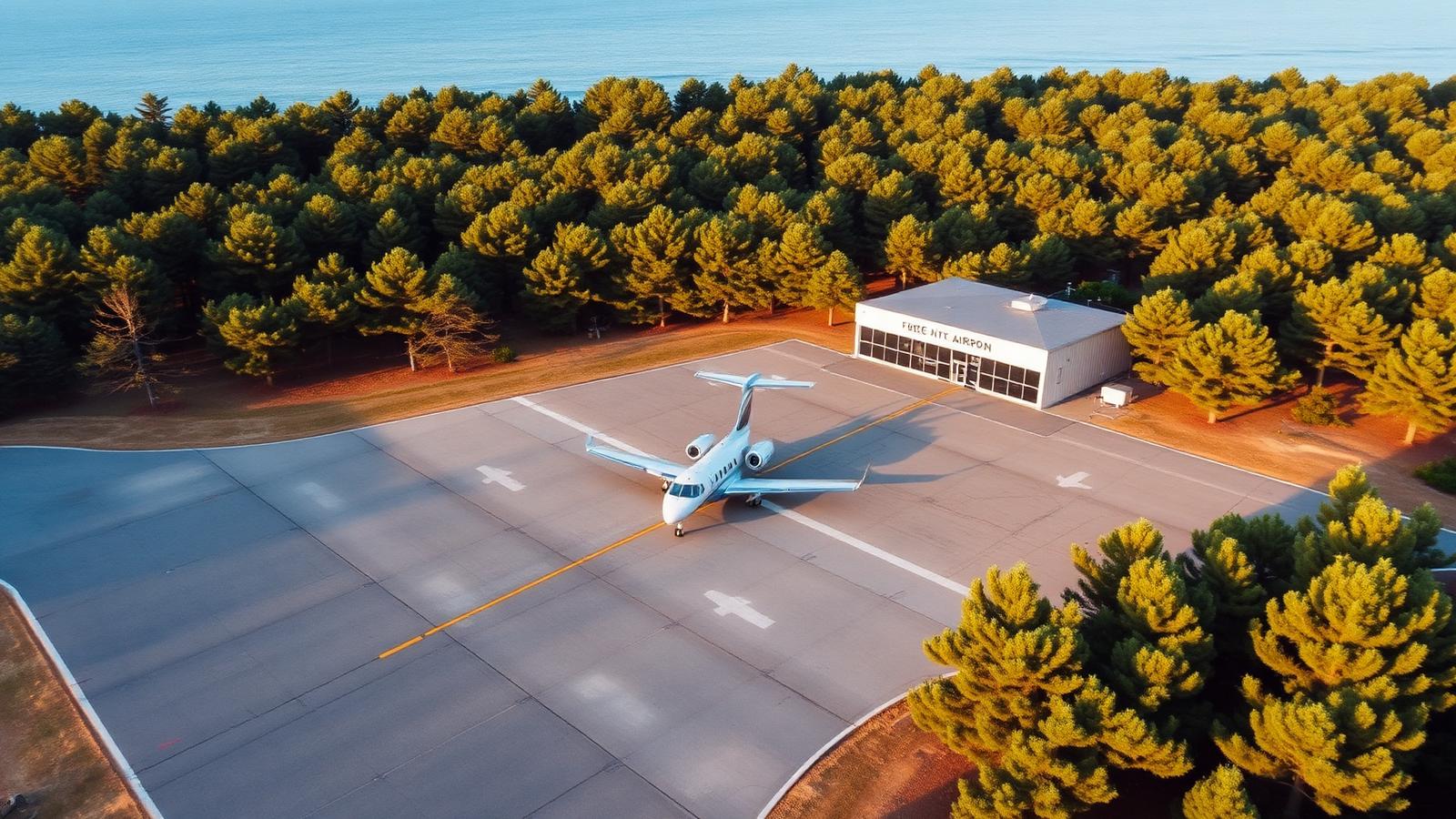
FBO Selection
The right airport is the single biggest time-saver on a private golf weekend — and the wrong one can wipe out two hours of the trip on each end.
An FBO is a Fixed Base Operator — the private-aviation terminal at an airport. The choice of FBO determines ramp time on arrival, ground-transport efficiency, and in many cases whether the aircraft can land at all. For destination golf, FBO selection is consistently underrated and consistently the largest avoidable friction in a private-jet trip.
The rule is simple: pick the smallest airport that comfortably accepts your aircraft type and sits closest to the property. The instinct to land at the largest nearby airport (because it's familiar) routinely costs 60–90 minutes per leg in taxi time, security routing, and ground transport.
The editor-tested FBO map below covers the destinations that matter most for golf travel. For each, we note the standard airport, the alternate for larger aircraft, and the practical gotchas — slot restrictions, runway length, customs, and ground-transport quality.
Bandon Dunes (Oregon)
Standard: North Bend (OTH), 25 minutes to the resort, accepts light and mid-size jets comfortably. Alternate: Eugene (EUG), 2 hours by car, handles larger aircraft. Heavy-jet only: Portland (PDX), 4 hours by car. The resort runs reliable ground transport from OTH; book it through the resort, not an outside operator.
Pebble Beach (California)
Standard: Monterey Regional (MRY), 15 minutes to The Lodge, handles up to super-mid jets. Alternate: San Jose (SJC), 90 minutes by car, accepts larger aircraft and runs more reliably in summer marine layer. Avoid Salinas (SNS) — the runway is short and ground transport is unreliable.

Pinehurst (North Carolina)
Standard: Moore County (SOP), 5 minutes to the resort, the closest option and accepts up to super-mid jets. Alternate: Raleigh-Durham (RDU), 75 minutes by car, the right choice for larger aircraft or international arrivals.
Augusta Week (Georgia)
Augusta Regional (AGS) is slot-controlled during Masters week with a separate-application process opened in fall of the prior year. Without a confirmed slot, plan for Atlanta-area FBOs (PDK is the standard, FTY a strong alternate) plus 2.5 hours of ground transport each way. Aiken (AIK) is the underused alternate — 30 minutes by car, no slot restriction, light and mid-size only.
St Andrews (Scotland)
Standard: Edinburgh (EDI), 90 minutes to the Old Course Hotel, the only realistic option for transatlantic jets. Dundee (DND) is closer (25 minutes) but accepts only light jets and is weather-sensitive. Glasgow (GLA) is a viable alternate if Edinburgh is weathered out.
About FBO Selection
- Does the FBO matter if I'm flying ad-hoc charter?
- Yes — the broker books wherever you direct, and a smart FBO choice can save 60–90 minutes per leg. The default to the largest nearby airport is almost always wrong.
- Who arranges ground transport from the FBO?
- Most resorts will collect you and your bags directly from the FBO if you give them the tail number and an ETA. This is faster and more reliable than booking an outside car service for the airport-to-resort leg.
- What about international customs?
- For US-bound transatlantic returns, plan a customs stop at a Class I FBO with US Customs and Border Protection on-site (Bangor BGR is the standard East Coast clearance stop). Building a customs leg into the itinerary is faster than asking customs to drive to a smaller airport.